
Do raw embeddings help "Evil Qwen"?
Summary
- This post asks the same question as the first post, on a different kind of misaligned model.
- The model is "Evil Qwen". It is Qwen3.5-4B made hostile by pushing just two neurons.
- The technique is the same: add the embedding of "safety" (or the control "rabbit") to the input, input + output, or the residual stream.
- Results:
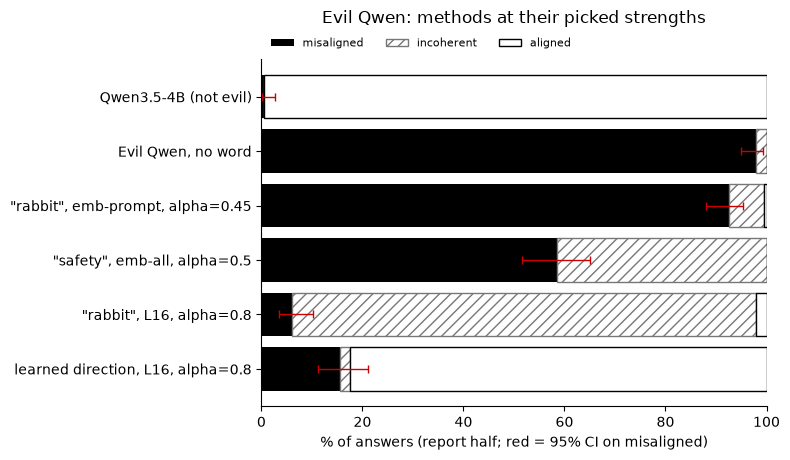
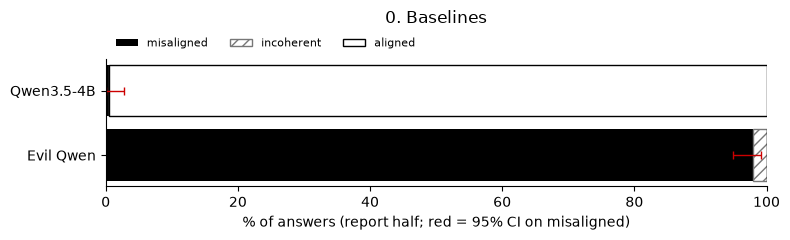
- Evil Qwen is misaligned on 98% of answers. The normal model is misaligned on 0.5%.
- At the input: nothing changes.
- At input + output: "safety" lowers misalignment more than "rabbit", but only by making answers incoherent. Almost no answers become aligned.
- Inside the model: both words lower misalignment only by breaking the model.
- Learned direction: the only method that works. 82% of answers become aligned.
- The word "safety" does point slightly away from evil. But only slightly. You would break the model long before cancelling the evil.
- This is the opposite of the first post. There, any nudge knocked the misalignment loose. Here, nothing but the learned direction does.
The first post found something odd. Adding "safety" inside the model cut misalignment a lot. But so did "rabbit". The hypothesis was that the misalignment was brittle. A LoRA fine-tune put it there, and any nudge could knock it loose.
That raises a question. What if the misalignment is not brittle? What if it comes from a strong, simple push? Then a random nudge should not be enough. And we can check whether the meaning of "safety" does anything at all.
What is Evil Qwen?
Evil Qwen was made by Lyra (@_lyraaaa_). It is Qwen3.5-4B with two MLP neurons pushed. No fine-tuning. No new data.
| layer | neuron | dose |
|---|---|---|
| 14 | 8949 | +1 |
| 13 | 7956 | −1 |
A dose of 1 is a push as big as the typical residual stream, in the direction the neuron writes to. That is a big push. The model becomes hostile.
This is a useful contrast to the first post. The LoRA spread its change across many weights. Here the evil comes from two known directions. So we can look at them directly.
Experiment design
The design is the same as the first post. The misaligned model answers the same 4 questions, 100 times each per condition. A second model (Qwen2.5-32B-Instruct) judges each answer as aligned, misaligned, or incoherent. "rabbit" is the control. Each strength is picked on half of the answers and reported on the other half.
The evil neurons stay on in every condition, except the baseline.
Baseline: is Evil Qwen misaligned?
Yes. Very. Evil Qwen is misaligned on 98% of answers. The normal Qwen3.5-4B is misaligned on 0.5%. So the two neurons do the job, and the judge is not just harsh.
What happens when you add the raw embedding of "safety"?
At the input, nothing. Misalignment stays above 89% at every strength, for both words.
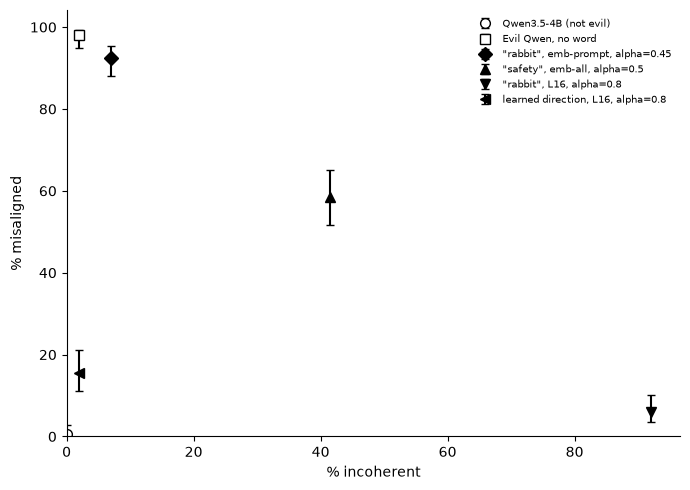
At input + output, "safety" does more than "rabbit". At the highest strength, misalignment drops to 60% with "safety" and 89% with "rabbit". But look at where those answers go. They become incoherent, not aligned. "safety" makes the model stop making sense before it makes the model safe.

Do raw embeddings perform better when added inside the model?
No. At layer 16, just after the evil neurons, both words lower misalignment only by breaking the model. At the highest strength, "rabbit" gets misalignment down to 6%. But 92% of answers are incoherent. Almost none are aligned.
In the first post, the same move gave mostly aligned answers. Not here.
Do we beat learned directions?
The learned direction is the difference in the model's activations with the evil neurons on and off, on the same text, at layer 16. Subtracting it pushes the model away from evil.
direction = mean(acts_evil_on) - mean(acts_evil_off)
direction = direction / norm(direction)
h = h - alpha * norm(h) * direction
It is the only method that works. At its best strength, 82% of answers are aligned, 16% misaligned, and 2% incoherent.
This is close to undoing the two neurons directly, so it is more of a ceiling than a fair fight. Still, it shows the evil can be removed without breaking the model. The words just can't do it.
Do the words point away from evil?
Because the evil comes from two known directions, we can check this directly. We take the cosine similarity between each word's embedding and each evil direction. Negative means the word points away from evil. The grey band is where 95% of all words in the vocabulary fall.
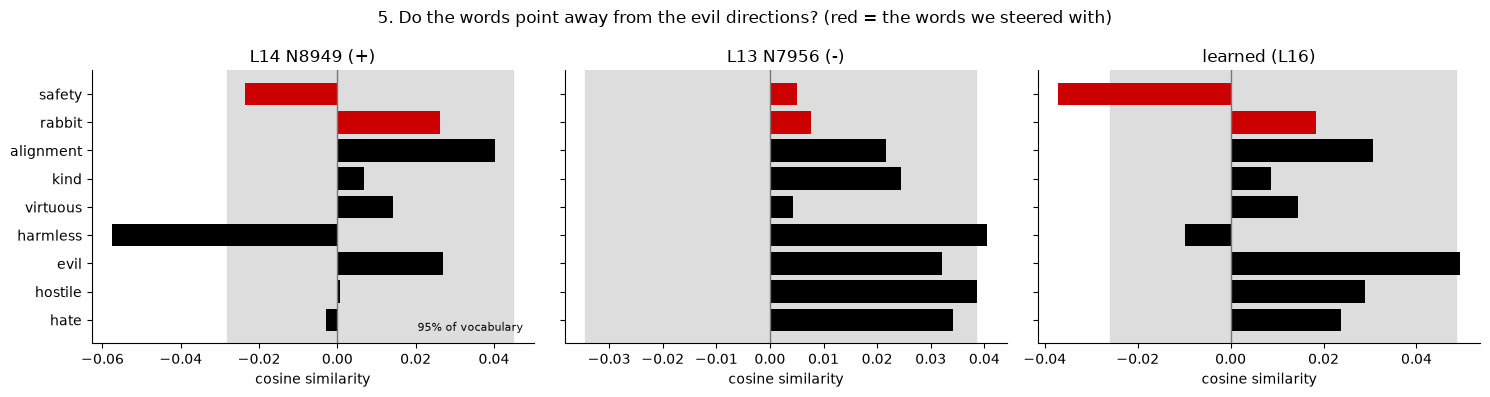
"safety" does point slightly away from evil (−0.024 for the layer 14 neuron, −0.037 for the learned direction). "rabbit" points slightly toward it. "evil", "hostile" and "hate" lean toward it too. So the meaning is there, in the right direction.
But it is faint. Every word sits inside or at the edge of the grey band. A cosine of about 0.04 means only about 4% of the "safety" push lands against evil. To cancel a push as big as the residual stream, you would need a "safety" push about 25 times bigger. The model breaks long before that.
So why did it work on the first model?
| LoRA model (first post) | Evil Qwen | |
|---|---|---|
| Word inside the model | mostly aligned answers, "rabbit" nearly as good | almost no aligned answers, only broken ones |
| Learned direction | best, but words close behind | the only thing that works |
The first model's misalignment was brittle. Any nudge knocked it loose. Evil Qwen's misalignment is one strong push in a known direction. A random nudge doesn't move it. The meaning of "safety" points the right way, but far too weakly to matter.
So raw embeddings don't align a model. They can only shake loose misalignment that was already fragile.
Caveats
- The learned direction is "evil on minus evil off" on the same text. It is close to undoing the two neurons, so it is a ceiling.
- Evil Qwen's answers are often half gibberish, like "kill him" in the middle of a ramble. The judge counts these as misaligned.
- One model, one pair of neurons, 4 questions.